
MUSCLE STABILITY AND PAIN SUPPORT TAPING
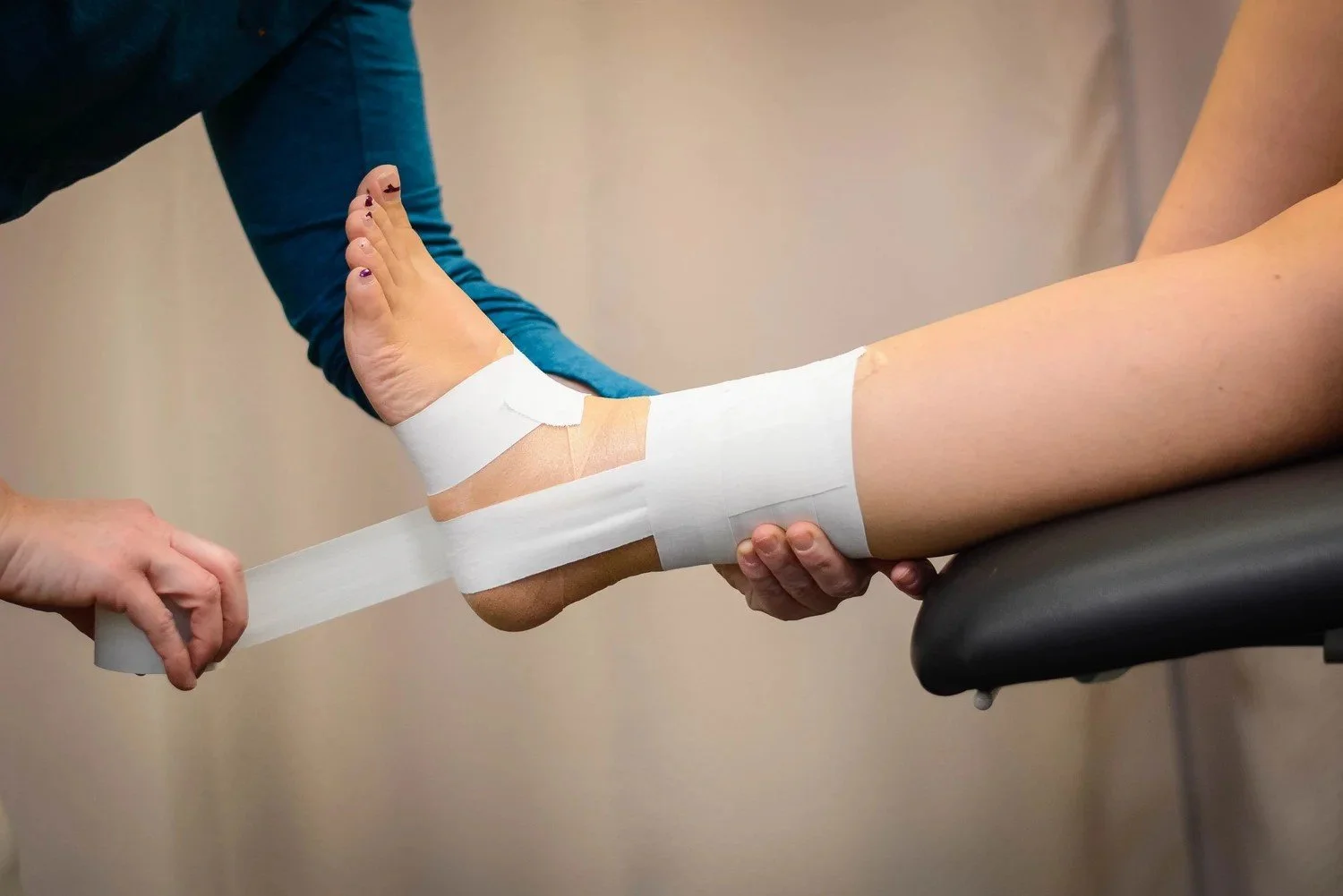
Physiotherapy taping is a technique using adhesive tape to support joints, muscles, and ligaments during physical activity. It can help reduce pain, limit harmful ranges of motion, improve proprioception, and enhance confidence in movement.
Two physiotherapy tapes: Provides strong mechanical support and restriction of movement. Often used for acute ankle sprains, unstable joints, and when maximal immobilization is needed. Requires careful application and usually pre-wrap to protect skin.
Common applications;
Ankle and Foot taping: For lateral ankle sprain prevention/support, platar facitis, facia tears, torn facia, tenodon and ligaments.
Thumb, hand and wrist taping: Provide stability for sprains or chronic instability and carpral tunnel syndrome.
Knee taping: Can address patellofemoral pain or provide mild and noderate medial/lateral support for ligament instability and pain relief.
Shoulder taping: To support rotator cuff muscles, reduce subacromial pain, reduce neck pain and assist posture.
Low back taping: Tape can be applied to support lumbar muscles, reduce pain, and cue posture. Rigid taping is used for heavier support in lifting, bending and picking up items.
Removal:
Remove tape slowly and carefully, ideally with the skin supported and tape pulled back over itself. Use adhesive remover for sensitive skin or if residue remains.
Please contact me if you have a question, concern or condition not listed to find out if taping can help ease your pain and get u moving faster.
For more healing information, create an account and sign-up for massage special pricing and deals on our monthly massage days.
MUSCLE STABILITY AND PAIN SUPPORT TAPING
Physiotherapy taping is a technique using adhesive tape to support joints, muscles, and ligaments during physical activity. It can help reduce pain, limit harmful ranges of motion, improve proprioception, and enhance confidence in movement.
Two physiotherapy tapes: Provides strong mechanical support and restriction of movement. Often used for acute ankle sprains, unstable joints, and when maximal immobilization is needed. Requires careful application and usually pre-wrap to protect skin.
Common applications;
Ankle and Foot taping: For lateral ankle sprain prevention/support, platar facitis, facia tears, torn facia, tenodon and ligaments.
Thumb, hand and wrist taping: Provide stability for sprains or chronic instability and carpral tunnel syndrome.
Knee taping: Can address patellofemoral pain or provide mild and noderate medial/lateral support for ligament instability and pain relief.
Shoulder taping: To support rotator cuff muscles, reduce subacromial pain, reduce neck pain and assist posture.
Low back taping: Tape can be applied to support lumbar muscles, reduce pain, and cue posture. Rigid taping is used for heavier support in lifting, bending and picking up items.
Removal:
Remove tape slowly and carefully, ideally with the skin supported and tape pulled back over itself. Use adhesive remover for sensitive skin or if residue remains.
Please contact me if you have a question, concern or condition not listed to find out if taping can help ease your pain and get u moving faster.
For more healing information, create an account and sign-up for massage special pricing and deals on our monthly massage days.